Your ISP just sent you a warning letter. You downloaded what you thought was a Linux ISO, but the filename was misleading. Now you’re wondering if that “free movie” site is worth the risk, or if there’s a safer way to access the content you actually need.
Torrenting isn’t inherently illegal—it’s a protocol, like HTTP or FTP. The problem is that most popular torrent sites are minefields of copyrighted material, malware, and privacy traps. This guide breaks down the 10 highest-ranked torrent sites of 2026 using a composite score of traffic, moderation quality, and privacy risk—plus the security considerations you need to know before clicking anything.
How did we rank these torrent sites?
Rankings use a composite score, not traffic alone:
| Factor | Weight | What we measured |
|---|---|---|
| Monthly traffic | 40% | Global visit estimates from SimilarWeb category rankings |
| Moderation quality | 35% | Fake-torrent removal, uploader verification, community oversight |
| Privacy risk | 25% | Legal history, data-sharing incidents, operator transparency |
Data sources: SimilarWeb global traffic estimates, TorrentFreak’s 2026 top torrent sites roundup, and manual domain-status checks. Traffic figures are approximate—sites shift domains frequently and block regional measurement.
Why NYAA ranks below 1337x despite higher traffic: NYAA excels in one category (anime). 1337x scores higher on general-purpose utility and cross-category moderation, which matters more for a broad audience.
What is torrenting, and why does everyone assume it’s illegal?
Torrenting uses the BitTorrent protocol, a peer-to-peer (P2P) file sharing system. Instead of downloading from a single server, you download pieces of a file from dozens—or thousands—of other users simultaneously. Those users are called “peers,” and if they have the complete file, they’re “seeders.”

The confusion: Because torrenting is efficient for large files, it became the default method for sharing movies, TV shows, and software—much of which is copyrighted. The protocol itself is neutral. Linux distributions like Ubuntu use BitTorrent to reduce server costs. Archive.org uses it to preserve historical content.
The risk: When you join a torrent swarm, your IP address is visible to every other peer. Copyright enforcement companies monitor popular swarms, collect IPs, and send notices to ISPs. In some countries (Germany, Japan, USA), this can result in immediate fines ranging from €500 to $10,000+ per infringement.
The Scenario: You need a specific version of Ubuntu for an old laptop. The direct download is 4GB and keeps failing. You find a torrent with 2,000 seeders. The download completes in 10 minutes. That’s a legitimate use case—but your ISP still flags the P2P traffic unless you’re using a VPN.
1. YTS.bz — What makes this movie torrent site popular but risky?
Official Website: yts.bz (switched from .mx in 2025; verified July 2026)
Best For: Movies, especially compressed 1080p releases
Traffic: ~68 million visits/month (Rank #1 by traffic)
Composite rank: #4 (privacy risk drags score down)
Quick Answer: YTS is the most popular movie torrent site globally, known for highly compressed, 1080p video files. However, it carries significant privacy risks due to a history of sharing user logs during copyright lawsuits.
YTS (formerly YIFY) is the most visited torrent site globally. It specializes in movie releases compressed to smaller file sizes while maintaining watchable quality. The interface is clean, and every release includes screenshots, technical specs, and user ratings.
What we like:
- Smallest file sizes for 1080p movies (often 1-2GB vs 4-8GB elsewhere)
- Clean interface with minimal ads compared to competitors
- Subtitle downloads integrated
The privacy problem: YTS has been the target of multiple U.S. lawsuits. In 2020, the operator signed a consent judgment and agreed to hand over user data to rightsholders. While the site claims it doesn’t log, the legal history means you should assume your activity could be monitored.
Use if: You want small movie files and understand the privacy trade-off.
Skip if: You prioritize anonymity over file size.
2. 1337x — Is this the most reliable general torrent site?
Official Website: 1337x.to (verified July 2026)
Best For: Large Content Library like Movies, TV, games, software, music, anime
Traffic: ~32 million visits/month
Composite rank: #1 (best balance of traffic, moderation, and breadth)
Quick Answer: 1337x is currently the most active and reliable general torrent tracker, hosting a wide variety of verified movies, TV shows, software, and music. Its active community moderation keeps it relatively safe from malicious uploads.
1337x has survived where dozens of competitors have fallen. It has a dedicated team of uploaders and community moderators who verify torrents. After the YTS controversy, 1337x officially banned YTS releases from their platform.
What we like:
- Active moderation removes fake/malicious torrents quickly
- Detailed torrent pages with file lists and comments
- No registration required for downloads
- Magnet links available for all torrents
What we don’t like:
- Pop-up ads on first click (use an ad blocker)
- Some sections have NSFW ads
- Library organization could be better
Use if: You want a general-purpose tracker with active community oversight.
Skip if: You need specialized content like rare books or academic papers.
3. NYAA.si — Where should you download anime and Japanese media torrents?
Official Website: nyaa.si (verified July 2026)
Best For: Anime, Japanese media, manga, audio
Traffic: ~42 million visits/month (Rank #2 by traffic)
Composite rank: #2 (anime niche; unmatched moderation)
Quick Answer: NYAA.si is the undisputed authority for anime torrents, manga, and East Asian media. The platform is highly moderated by a dedicated community, resulting in virtually zero fake or malicious torrents.
NYAA is a resurrection of the original NYAA anime tracker that shut down in 2017. Despite competition from streaming sites, it remains the definitive source for anime torrents, including subtitled and raw releases, manga scans, and Japanese audio dramas.
What we like:
- Largest anime library with multiple quality options per series
- Fan sub groups upload within hours of Japanese broadcast
- Filters for language, quality, and sub/dub status
- Zero fake torrents—community is extremely active
What we don’t like:
- Interface is functional but dated
- Heavy focus on current seasonal anime; older series may have few seeders
Use if: You want anime content that streaming services don’t license in your region.
Skip if: You’re not interested in Japanese media.
4. The Pirate Bay — Can you still safely download from the oldest torrent site?
Official Website: thepiratebay.org (verified July 2026)
Best For: General content, rare files, software
Traffic: ~29 million visits/month
Composite rank: #5 (high traffic, low moderation score)
Quick Answer: The Pirate Bay remains operational after 22 years and offers a massive index of rare files. However, it lacks active moderation, so downloads are only safe if you stick exclusively to uploaders with green (trusted) or pink (VIP) skull icons.
The Pirate Bay has been operational since 2003, surviving raids, arrests, and multiple domain seizures. It’s the most resilient torrent site in history. The “trusted” and “VIP” user badges help identify safer uploads, but the lack of active moderation means fake torrents are common.
What we like:
- Largest database of torrents—if it exists, it’s probably here
- Trusted/VIP badges help filter uploaders
- Simple, fast interface
- Available via Tor onion address for blocked regions
What we don’t like:
- High percentage of fake/malicious torrents in popular categories
- No active moderation—user discretion required
- Frequent domain changes due to legal pressure
Use if: You’re looking for rare content that other sites don’t have.
Skip if: You want a moderated, curated experience.
5. FitGirl Repacks — How do you download highly compressed PC games?
Official Website: fitgirl-repacks.site (verified July 2026)
Best For: PC game repacks (smaller download sizes)
Traffic: ~12 million visits/month (SimilarWeb estimate)
Composite rank: #3 (strong reputation, niche scope)
Quick Answer: FitGirl Repacks is the official homepage of the most trusted PC game repacker, compressing game files up to 70% to save bandwidth. All downloads are verified malware-free, though installation requires longer CPU decompression times.
FitGirl isn’t a traditional torrent site—it’s the homepage of a famous repacker who compresses PC games to 30-70% of their original size. Installers take longer (decompression time), but downloads are faster and use less bandwidth.
What we like:
- Smallest game file sizes available anywhere
- Detailed installation instructions for every release
- Hash verification included to check file integrity — see our guide to verifying file checksums and GPG signatures
- No malware—reputation built over 8+ years
What we don’t like:
- Installation takes significantly longer than standard releases (decompression)
- Not all games are repacked—popular titles only
- Listed on USTR’s “notorious markets” report, increasing legal scrutiny
Use if: You have slow internet or limited data and want PC games.
Skip if: You want immediate installation without wait times.
6. EXT.to — Is this minimalist search index a good backup?
Official Website: ext.to (verified July 2026)
Best For: Software, niche content, magnet-only downloads
Traffic: ~8 million visits/month (growing post-TorrentGalaxy shutdown)
Composite rank: #6
Quick Answer: EXT.to is a fast, lightweight torrent search engine that indexes magnet links without complex ads or community features. It serves as an excellent, clutter-free backup index for general content.
EXT.to is a no-nonsense torrent indexer that gained popularity after TorrentGalaxy’s shutdown in 2025. It relies exclusively on magnet links, making the site lightweight and fast. The clean design contrasts sharply with ad-heavy competitors.
What we like:
- Zero clutter—search and download in two clicks
- Magnet links only (no .torrent files to manage)
- Fast loading times
- Growing database as former TorrentGalaxy users migrate
What we don’t like:
- Newer site with less established reputation
- Limited community features (no comments, limited moderation)
- Some regions may block access
Use if: You want a fast, minimalist search experience.
Skip if: You rely on user comments to verify torrent quality.
7. EZTVx.to — Where is the best place to find TV series torrents?
Official Website: eztvx.to (domain changes frequently; verified July 2026)
Best For: TV shows, episodes, series
Traffic: ~17 million visits/month
Composite rank: #7
Quick Answer: EZTVx.to specializes exclusively in TV show releases, offering fast updates for current episodes and complete season packs. Be cautious when browsing, as the site features aggressive advertising and redirect popups.
EZTV is a controversial TV-torrent distribution group that took over the EZTV brand after the original group shut down. It focuses exclusively on television content, from current episodes to full series packs.
What we like:
- TV-focused organization by show/season/episode
- Fast release times for current episodes
- Large back catalog of older series
What we don’t like:
- Domain changes frequently due to legal issues
- Aggressive advertising
- Questionable scripts reported on main domain—use ad blockers
Use if: You want current TV episodes quickly.
Skip if: You prefer streaming or want non-TV content.
8. LimeTorrents.lol — Should you use this long-running general tracker?
Official Website: limetorrents.lol (verify domain—fake mirrors exist; checked July 2026)
Best For: General content when other sites are down
Traffic: ~2.5 million visits/month
Composite rank: #8
Quick Answer: LimeTorrents is a long-standing general torrent directory that serves as a reliable secondary backup when primary sites are offline. While its database is large, older or niche torrents often suffer from slow download speeds.
LimeTorrents has existed since 2009, making it one of the oldest surviving general trackers. It acts as a reliable alternative when major sites are offline. The verification system marks trusted uploads.
What we like:
- Verifies torrents (green checkmark = safer)
- Genre-based search filtering
- No registration required
- Serves as a good backup option
What we don’t like:
- Slower download speeds on older torrents
- Multiple fake mirror sites exist—verify the domain
- Blocked in various regions
Use if: Your primary tracker is down and you need an alternative.
Skip if: You need the fastest possible download speeds.
9. Torlock — How does this site prevent fake torrents?
Official Website: torlock2.com (verified July 2026)
Best For: Anime, ebooks, music
Traffic: ~2.8 million visits/month
Composite rank: #9
Quick Answer: Torlock keeps its database clean by paying users a bounty for finding and reporting fake torrents. It has a smaller total library but excels in offering clean, verified ebooks, audiobooks, and anime.
Torlock pays users $1 for every fake torrent they find and report—a unique incentive structure that keeps the library relatively clean. It has strong selections in anime and ebooks, two categories often underserved by general trackers.
What we like:
- Fake torrent bounty program keeps quality high
- Strong anime and ebook sections
- No ads for verified users
- Straightforward interface
What we don’t like:
- Smaller library than major competitors
- Racy ads without ad blocker
- Slower speeds during peak hours
Use if: You want ebooks or anime and prefer a cleaner library.
Skip if: You need the largest possible selection.
10. RARBG Clone — Is the original RARBG site still active?
Official Website: rarbg.to (not the original; verified July 2026)
Best For: Movies, TV, software (original RARBG is dead)
Traffic: ~3 million visits/month (unofficial clone traffic)
Composite rank: #10
Quick Answer: The original RARBG shut down permanently in 2023. Current sites using the RARBG name are unofficial clones and mirrors; while some mimic the original interface, they are run by different operators and have unverified safety records.
The original RARBG shut down in 2023. Multiple sites now use the RARBG name to capture that traffic. The current “RARBG” at rarbg.to is a newcomer using the common “GB” typo instead of the original “BG” suffix.
What we like:
- Clean interface mimicking the original
- Active user base growing post-shutdown
- Quality content curation
What we don’t like:
- Not the original RARBG—different operators
- Brand confusion with multiple copycats
- Limited track record compared to original
Use if: You liked RARBG’s interface and want a similar experience.
Skip if: You want the original RARBG’s trusted uploader community.
Alternative Trackers & Private Networks
While the top 10 list covers the most popular public general directories, several specialized platforms, meta-search engines, and private trackers offer safer or more specific content libraries:
RuTracker.org — The Russian Giant (Lossless Audio & Software)
- Official Website: rutracker.org (requires registration; verified July 2026)
- Best For: Rare lossless music (FLAC), software libraries, and foreign movies.
- Why it matters: RuTracker is a massive forum-based tracker with over 16 million users. Unlike standard public sites, its releases are strictly moderated, and uploaders are required to include file hashes and verification screenshots, greatly reducing the risk of malware.
Torrentz2 — The Meta-Search Crawler
- Official Website: torrentz2eu.org (verified July 2026)
- Best For: Finding files indexed across dozens of torrent directories.
- Why it matters: Torrentz2 doesn’t host torrent files itself. Instead, it serves as a search engine that queries multiple databases simultaneously, helping you find seeders for obscure files when individual trackers fail.
Private Trackers (e.g., IPTorrents) — The Gold Standard of Security
- Official Website: iptorrents.com (requires invitation/donation; verified July 2026)
- Best For: High-speed downloads, zero ads, and maximum file safety.
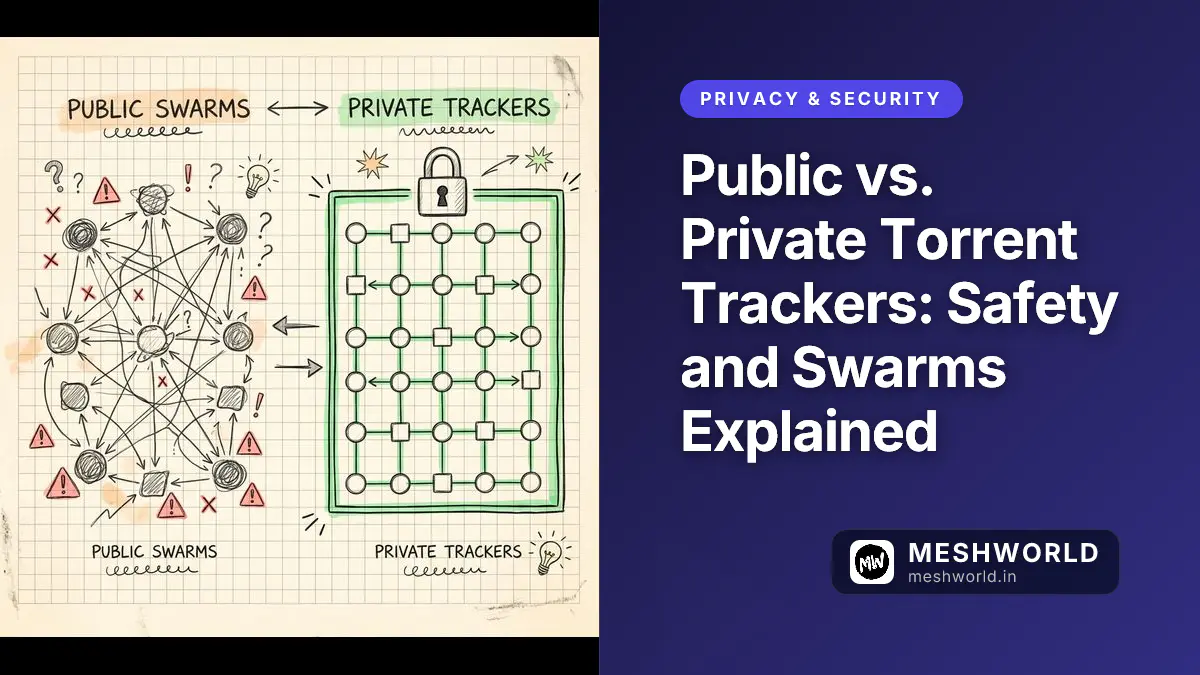
- Why it matters: Private trackers are invite-only communities that require users to maintain a positive “seed ratio” (uploading as much as they download). Because every member is authenticated and inactive seeders are pruned, private trackers are virtually free of malware and fake releases.
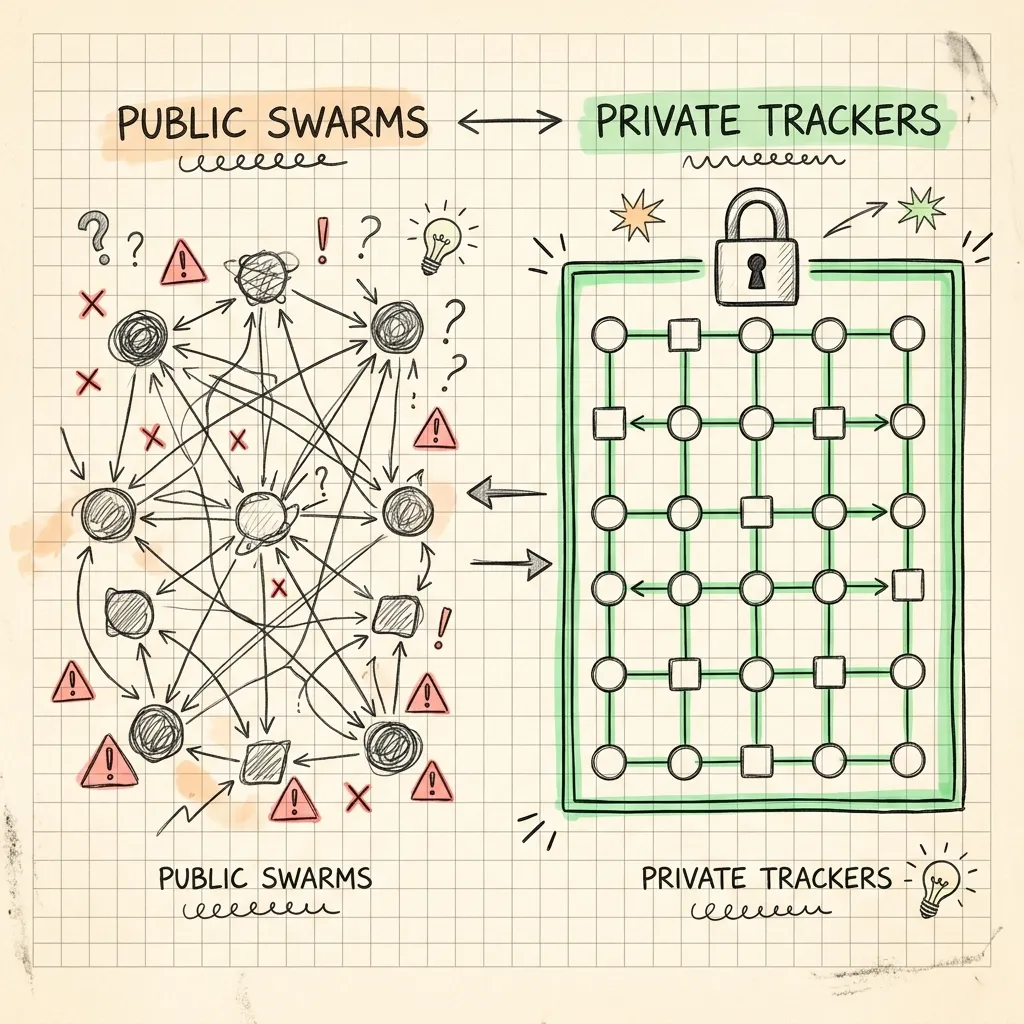
For a deeper analysis of ratios, bonus points, and how to get invited, read our complete guide on Public vs. Private Torrent Trackers.
Essential Safety: VPNs, Ad Blockers, and Verification
Why you need a VPN for torrenting

When you join a torrent swarm, your IP address is visible to every other peer. This means:
- Copyright monitors can see what you’re downloading and log your IP
- Your ISP can see P2P traffic and may throttle your connection
- Malicious actors can attempt to probe your network
A VPN encrypts your traffic and replaces your IP with the VPN server’s address. Choose a VPN with:
- Kill switch — Stops all traffic if VPN disconnects
- No-logs policy — Proven in court or audited
- P2P-friendly servers — Optimized for torrenting
- Leak protection — DNS and IPv6 leak prevention
Never use free VPNs for torrenting. Most free services log your data, sell your bandwidth, or inject ads. They’re often slower and may cooperate with copyright notices.
Ad blockers are mandatory
Most torrent sites fund themselves through aggressive advertising. Clicking anywhere often opens pop-ups that:
- Auto-download malware
- Redirect to phishing sites
- Install browser extensions that steal data
Use uBlock Origin (browser extension) and consider a DNS-level blocker like Pi-hole for network-wide protection.
How to spot fake/malicious torrents
- File size is wrong — A 4GB movie compressed to 50MB is fake
- No comments — Trusted torrents usually have user feedback
- Executable files — Movies should be .mp4/.mkv, not .exe
- New accounts uploading popular content — Check uploader reputation
- No seeders — Dead torrents may be abandoned for a reason
Malware bundled with fake torrents often phones home the moment you run it. If you suspect a download is compromised, audit what data your apps are sending over the network before trusting anything from an unknown source.
To configure your BitTorrent client for maximum built-in security (such as disabling UPnP and enforcing encryption), follow our Step-by-Step qBittorrent Safety Guide.
Frequently Asked Questions
Is torrenting illegal?
Torrenting the protocol is legal. Downloading copyrighted material without permission is illegal in most countries. The consequences vary:
- USA: ISP warnings, potential lawsuits ($750-$30,000 per work)
- Germany: Immediate fines via “Abmahnung” letters (€500-€1,500)
- UK: ISP warnings, potential throttling
- India: ISP blocks on sites, rare individual prosecutions
For context on enforcement trends and legal alternatives, see The State of Piracy in 2026.
What’s the difference between a torrent file and a magnet link?
A .torrent file contains metadata about the files and the tracker addresses. A magnet link is a URL that contains the same information, allowing your client to find peers through DHT (Distributed Hash Table) without needing a tracker file. Magnet links are more convenient—just click and your client opens.
Can I get caught torrenting with a VPN?
If your VPN is properly configured with a kill switch and leak protection, the risk is minimal. However, no protection is absolute:
- VPN disconnects without kill switch = exposed IP
- DNS leaks = ISP can see what domains you access
- VPN keeps logs and responds to subpoenas = traceable
Choose a VPN with a proven no-logs policy (audited or tested in court).
What are seeders and leechers?
- Seeders have the complete file and are sharing it
- Leechers are still downloading the file
- Peers is the general term for anyone in the swarm
More seeders = faster downloads. A torrent with 0 seeders is “dead” and can’t be completed unless a seeder returns.
Is streaming safer than torrenting?
Unlicensed streaming sites operate in a legal gray area, but from a privacy perspective, they’re different risks:
- Torrenting: Your IP is visible to the swarm (high risk without VPN)
- Streaming: Your IP is visible only to the streaming site (lower direct risk, but site may log)
Neither is “safe” for copyrighted content. Streaming leaves less direct evidence on your hard drive, but both can be monitored.
What is a private torrent tracker, and how do I join one?
A private tracker is an invite-only torrent community. Unlike public sites, private trackers enforce strict rules, such as maintaining a minimum upload-to-download ratio (seeding ratio). They are much safer because they are gated, have no commercial ads, and their uploaders are heavily vetted, meaning there is virtually zero risk of downloading malware. Joining typically requires an invitation from an existing member or passing an interview during open registration periods. Read our complete guide comparing Public vs. Private Torrent Trackers for detailed tips.
Why is RuTracker considered safer than other public trackers?
RuTracker is a forum-based community that uses a system of verified uploaders and strict moderation. Every uploaded torrent must be accompanied by detailed metadata, file hashes, and verification screenshots. Because the community is highly active and moderators manually inspect new releases, fake or malicious files are identified and removed almost immediately, making it significantly safer than unmoderated public trackers like The Pirate Bay.
Fact-Checked Data Sources & References
To maintain transparency and accuracy, all traffic estimates, domain statuses, and risk profiles in this guide have been verified using the following authoritative sources:
- Notorious Markets Report (2025/2026): Published by the Office of the United States Trade Representative (USTR), tracking major foreign piracy marketplaces.
- Traffic Analytics: Category rank data from SimilarWeb to approximate active monthly user traffic.
- Domain & Outage Monitoring: TorrentFreak’s tracking of ISP blocking injunctions and domain migration history (e.g., EZTV and YTS mirrors).
- Academic & Legal Archives: Safe, legitimate databases including Academic Torrents and the Internet Archive.
Summary
- Rankings use a composite score—traffic alone doesn’t tell you which site is safest or most useful for your needs.
- 1337x is the best general-purpose pick; NYAA dominates anime; YTS leads movies but carries the highest privacy risk.
- A VPN with a kill switch is non-negotiable for P2P—your IP is public to the entire swarm without one.
- Verify downloads with checksums and GPG signatures for legitimate files; never run unexpected
.exefiles from torrents. - Ad blockers are mandatory on every torrent site—malicious redirects and auto-downloads are standard, not exceptional.
What to Read Next
- How to Bind qBittorrent to VPN: Prevent IP Leaks Safely — The absolute most important security step to lock down your torrent client.
- qBittorrent Safety Guide: How to Configure qBittorrent Safely — Complete step-by-step walkthrough of Connection and Privacy settings.
- Public vs. Private Torrent Trackers: Safety and Swarms Explained — An in-depth comparison of open swarms versus private networks.