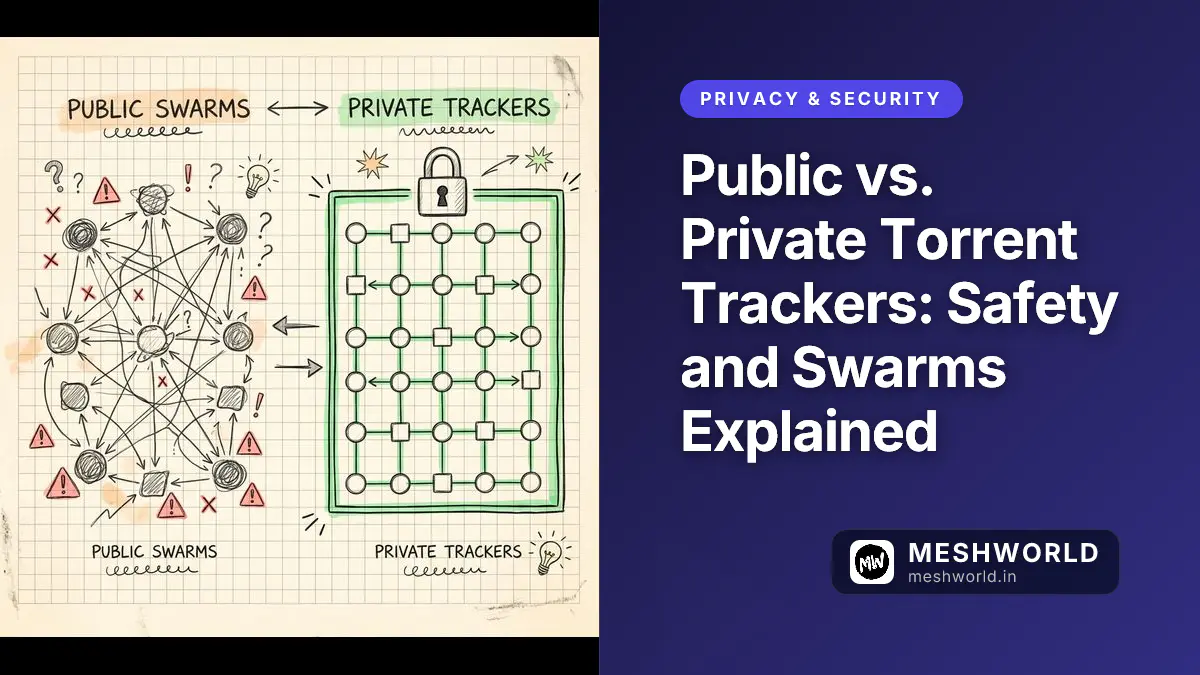
If you get your torrent files from open search directories, you are sharing files in an unregulated public swarm, exposing your network address and risking malware infections. Private torrent trackers offer invite-only communities where users are vetted, files are strictly moderated, and high-speed seeding is mandatory. This guide breaks down the core structural, privacy, and security differences between public and private P2P networks, helping you determine if making the transition is worth it.
Prerequisites
To participate in P2P sharing, you need:
- A secure P2P client installed (see our qBittorrent Safety Configuration Guide)
- An active VPN with network interface binding configured
What is a public torrent tracker?
A public tracker is a P2P indexer open to the public without registration or fee. Anyone can browse the site, download .torrent or magnet links, and immediately join the file-sharing swarm.
The Pros:
- Free and open access (no accounts needed).
- Massive catalog of popular movies, music, and software.
- High seeder counts on newly released, trending content.
The Cons:
- Zero Privacy: Your IP address is visible to everyone in the swarm, including copyright monitoring agencies.
- Malware Risk: Uploaders are anonymous; fake torrents containing malware are common.
- Intrusive Advertising: Sites rely on aggressive, often malicious popup advertisements.
What is a private torrent tracker?
A private tracker is a closed P2P community that requires registration: typically invitation-only. The tracker monitors user behavior, enforcing strict rules on download and upload statistics.
The Pros:
- Extreme Speed: Members are required to seed, meaning torrents have high bandwidth allocations and rarely die.
- Vetted Safety: Uploaders are verified, and malicious files are deleted within minutes.
- No Ads: Private trackers are funded by member donations and are ad-free.
- Organized Curation: Torrents are properly tagged, include verified descriptions, and have multiple quality options.
The Cons:
- Difficult Access: You cannot join without an invite or donation.
- Strict Rules: Failing to maintain your seed ratio results in an immediate ban.
- Obscure Content: Niche trackers are highly specialized, meaning a single private tracker may not have everything you need.
How do public and private trackers compare?
The diagram below outlines the core differences in swarm composition, security, and accessibility:
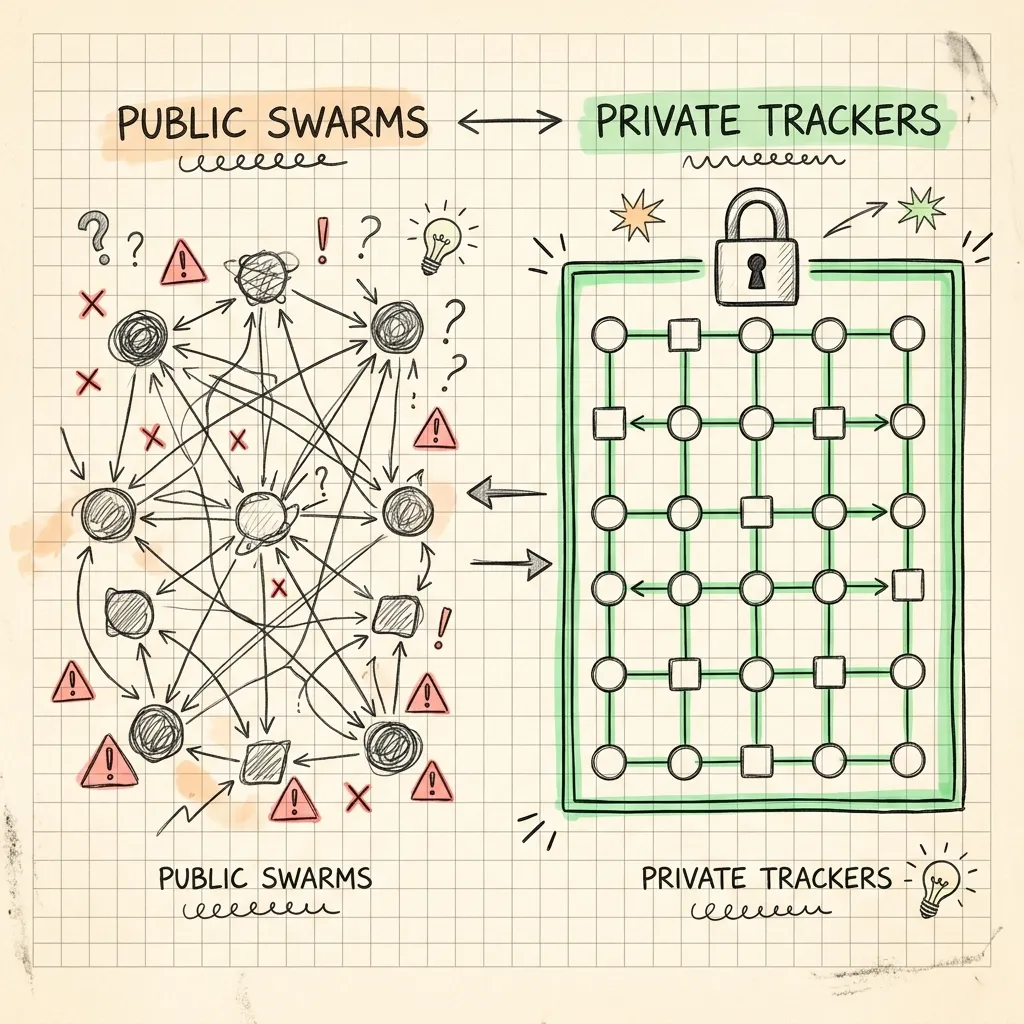
Here is a quick summary of the tradeoffs:
| Feature | Public Trackers | Private Trackers |
|---|---|---|
| Access | Open to anyone | Invite or Donation only |
| Security | High malware risk | Vetted, virtually malware-free |
| Download Speeds | Highly variable | Consistently high (saturates connection) |
| Seeding Requirement | None (leads to dead torrents) | Strict ratio enforcement (keeps torrents alive) |
| Ads & Popups | Aggressive, often malicious | None (donation funded) |
| VPN Required | Strictly Mandatory | Highly recommended (for ISP shielding) |
What are the rules and seed ratios for private trackers?
Private trackers function on reciprocity. To prevent “leeching” (downloading files and immediately deleting them), trackers enforce a Seed Ratio:
Seed Ratio = Uploaded Data (GB) / Downloaded Data (GB)If you download a 10GB game, you are expected to upload 10GB back to the community (a ratio of 1.0). If your ratio drops below a certain threshold (usually 0.5 to 0.8), your account enters a warning state. If you do not improve it by seeding your downloaded files, your account is permanently banned.
To help users build ratio, trackers use two mechanisms:
- Freeleech: Torrents marked as Freeleech do not count toward your download statistics, but any data you upload does count toward your upload statistics. This is the primary way new users build buffer.
- Bonus Points: Seeding active torrents generates bonus points over time, which can be exchanged for uploaded gigabytes.
How do I join a private torrent tracker?
Joining a private tracker takes patience and effort. Here are the three primary entry routes:
- Invite Threads: Vetted users on technology forums or subreddits (like
r/trackers) have invite privileges. Build a reputation, demonstrate good seed ratios from lower-tier trackers, and request invites. - Open Signups: Some mid-tier trackers open registration for 24-48 hours. Monitor trackers tracking sites (like
opentrackers.org) to register during these windows. - Interview Processes: Elite trackers (like RED or MAM) run open IRC-based interviews where they test your understanding of audio formats, transcoding rules, and seeding etiquette.
Summary
- Public Swarms: Best for casual, non-critical downloads; require a VPN and ad blocker.
- Private Clubs: Best for power users who value speed, safety, and catalog organization; require ratio discipline.
- Security: Private trackers eliminate malware and aggressive ads, but have a high barrier to entry.
Frequently Asked Questions
Do I still need a VPN on private trackers?
Yes. While private swarms are closed, rightsholders and copyright agencies can still obtain invites to monitor elite trackers. A VPN shields your IP address from peers, and prevents your ISP from identifying P2P traffic.
What is a “Seedbox”?
A seedbox is a remote, high-bandwidth server (usually hosted in a datacenter in a P2P-friendly country like the Netherlands) dedicated to downloading and seeding torrents 25/7. Power users on private trackers use seedboxes to easily maintain ratios of 10.0+ using gigabit uplink connections.
Are all private trackers general-purpose?
No. Most elite trackers are highly specialized. For example, Bibliotik is for ebooks, RED (Redacted) is for music, GazelleGames is for PC/console games, and BroadCity is for television.
What to Read Next
- 10 Best Torrenting Sites of 2026: Privacy, Speed, and Safety Ranked — Review the top public trackers.
- qBittorrent Safety Guide: How to Configure qBittorrent Safely (2026) — Harden your client connection settings.
- How to Bind qBittorrent to VPN: Prevent IP Leaks Safely — Bind your client interface.