

In 2026, we are past the point where an agent typing code into a terminal is a magic trick. We need reliability. When developers look at agentic frameworks, the choice often comes down to the Wild West of open-source (AutoGPT) versus the walled garden of big tech (OpenAI Agents SDK).
If you choose the wrong one, you will either spend your weekends debugging infinite loops, or you will be locked into a vendor that charges you $5 every time your agent sneezes.
Here is the objective breakdown.
AutoGPT: The Open-Source Hacker’s Dream
AutoGPT started as a viral GitHub repo and evolved into a massive, community-driven framework. It is designed to be the ultimate generalist. You give it a goal, and it will write scripts, browse the web, and recursively prompt itself until it succeeds (or crashes).
- Core Philosophy: Maximum autonomy and zero lock-in.
- The Vibe: It feels like building a custom race car. It’s incredibly fast, totally unregulated, and it might explode.
Why you’ll love it:
- Infinite Extensibility: Because it’s Python-native and open-source, you can wire it up to literally any API or local model (like Llama 4) without asking for permission.
- Cost Control: You aren’t forced to use expensive frontier models. You can run the entire agentic loop locally.
Why you’ll hate it:
- The Infinite Loop: AutoGPT is famous for getting stuck in “Death Spirals” where it tries to fix a bug by running the exact same failed code 400 times. You have to build your own guardrails.
The Scenario: You want to build a local agent that manages your personal server infrastructure without sending your private logs to a corporate API. You use AutoGPT, connect it to a local Llama model, and let it manage your Docker containers.
OpenAI Agents SDK: The Managed Enterprise
OpenAI realized developers were struggling to manage state, context windows, and tool-calling schemas. So, they built the Agents SDK. It handles the heavy lifting of the “Observe-Think-Act” loop on their servers.
- Core Philosophy: Developer experience and reliability.
- The Vibe: It feels like using a premium Apple product. Everything just works, but you have to do things their way.
Why you’ll love it:
- Zero Infrastructure: You don’t need a vector database or a complex state manager. OpenAI handles the “Thread” and the “Memory” natively.
- Reliability: Function calling (Tools) works almost flawlessly with GPT-4.5 and GPT-5 models.
Why you’ll hate it:
- Vendor Lock-in: You are completely reliant on OpenAI’s ecosystem. If they change their pricing or deprecate an API, your entire architecture breaks. You cannot easily swap in an open-source model.
The Scenario: Your boss tells you to add an “AI Support Assistant” to the company’s React app by Friday. You use the OpenAI Agents SDK (via Vercel AI SDK). You define the tools, point it at your Stripe API, and deploy it. It works perfectly on day one.
The Direct Comparison
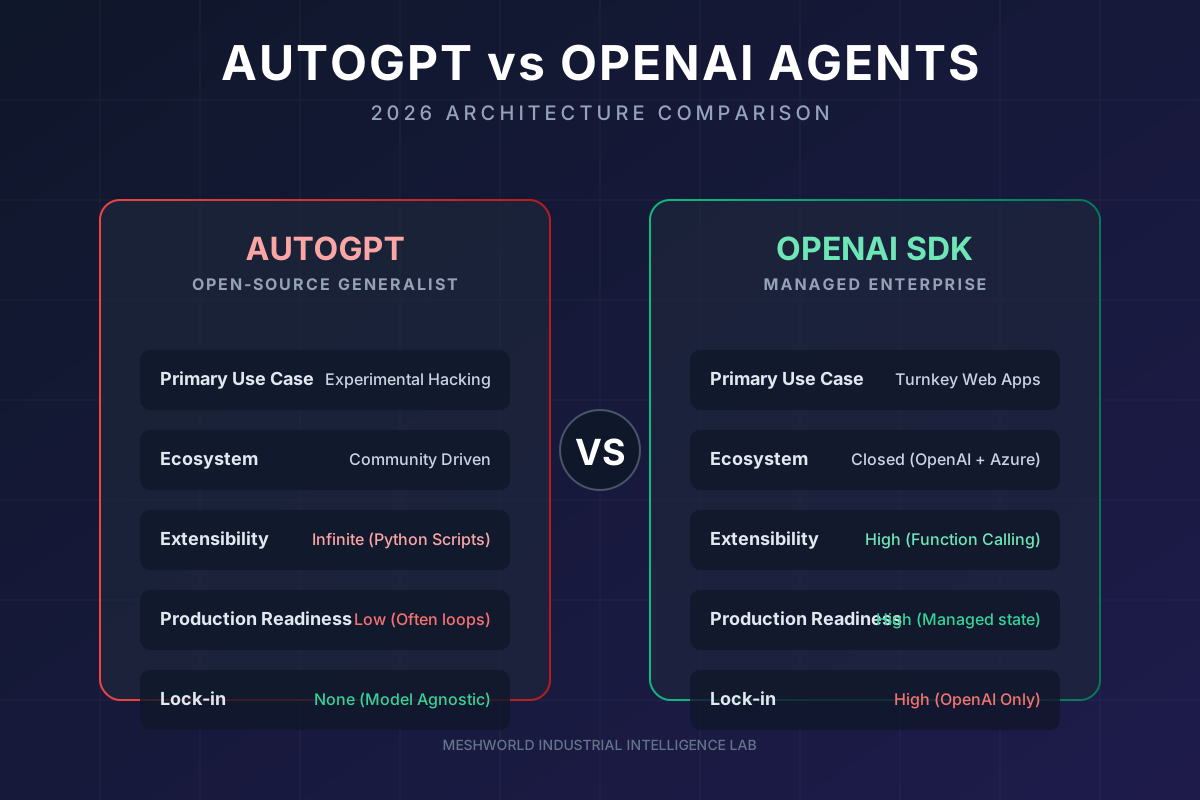
| Feature | AutoGPT | OpenAI Agents SDK |
|---|---|---|
| Primary Use Case | Experimental Hacking | Turnkey Web Apps |
| Ecosystem | Community Driven | Closed (OpenAI + Azure) |
| Extensibility | Infinite (Python Scripts) | High (Function Calling) |
| Production Readiness | Low (Requires heavy guardrails) | High (Managed state) |
| Lock-in | None (Model Agnostic) | High (OpenAI Only) |
Which One Should You Choose?
- Choose AutoGPT if: You are a researcher, a hobbyist, or building an internal tool where data privacy mandates local execution.
- Choose OpenAI Agents SDK if: You are building a consumer-facing web app and you prioritize shipping speed and reliability over architectural independence.
Next Step: Want to see how the other big players compare?
→ Read: LangChain vs. CrewAI Comparison
Back to the main guide: AI Agents: The Complete Developer Guide