The $2 billion acquisition of Manus AI by Meta was supposed to be the opening salvo in the era of consumer-grade autonomous agents. Instead, it became the first major casualty of the US-China technological cold war. Chinese regulators blocked the deal, and a subsequent multibillion-dollar buyback by Tencent and Sequoia China fragmented the global AI landscape, drawing a hard national boundary around the code that controls our computers.
Why Did Meta Want to Buy Manus AI?
To understand the scale of the Meta-Manus deal, you need to look at the competitive pressure mounting in Silicon Valley in late 2025. The race for raw LLM intelligence (text in, text out) had hit diminishing returns. The industry realized the next frontier was action—autonomous systems that could operate computers like humans.
Microsoft was integrating OpenAI’s Operator agent directly into Windows, and Anthropic was capturing developers with Claude’s local terminal and browser automation (Claude Code). Meta, despite having the industry-standard open-weights model in Llama, lacked a dedicated agentic runtime. No sandboxed cloud OS that could execute tasks, browse the web, and run code on its own.
Manus AI, a lean startup that went viral in 2025 for its general-purpose agent VM, was the perfect shortcut. By acquiring Manus, Meta aimed to achieve three strategic objectives:
- Immediate Consumer Scale: Integrating Manus’s autonomous browser and desktop automation into WhatsApp, Messenger, and Instagram. Picture telling Meta AI in a WhatsApp chat to “research the best flights to Mumbai, book the hotel, and compile the itinerary into a PDF” and having the agent spin up a headless Chromium container to do it.
- Developer & Workspace Supremacy: Giving Meta’s Llama models a native, sandboxed execution environment. Meta wanted to build a developer portal where engineers could deploy Llama-powered agents to run scripts, manage files, and automate CI/CD pipelines without building the virtualization infrastructure themselves.
- Hardware-Software Synergy: Manus’s models were trained on hundreds of thousands of browser interaction traces. By placing the Manus team inside Meta’s infrastructure, Meta could leverage its vast GPU clusters to train agent models at a scale no independent startup could match.
The synergy was clear. Meta had the compute, the capital, and the distribution. Manus had the specialized reinforcement learning pipelines and the sandboxed VM runtime.
What Made the Manus Technology So Valuable?
The value of Manus AI didn’t lie in its raw LLM parameters. Manus used a combination of proprietary fine-tuned models and open-source models. The true value was the orchestration layer and the closed-loop execution environment.
Unlike typical conversational assistants that make API calls to retrieve information, Manus developed a proprietary architecture for operating system control:
- The Virtualized Sandbox: Manus engineered a disposable container system that spins up a full Linux environment with a Chromium browser, terminal shell, and file system in less than a second. Managing thousands of concurrent disposable VMs at low latency was a massive engineering achievement.
- Vision-Verification Loops: Rather than relying solely on DOM parsing—which breaks when websites change their HTML—Manus trained visual models to process screenshots of the virtual screen in real time. The agent looked at the browser like a human, verifying that a button was clicked or a form was submitted before moving on. This visual loop dramatically reduced task failure rates.
- 强化学习 (Reinforcement Learning from Computer Interactions): The team collected millions of hours of expert computer usage datasets, training their models specifically on mouse movements, keyboard inputs, terminal commands, and error-recovery behaviors.
For Meta, building this virtualization infrastructure, visual verification loop, and specialized dataset from scratch would have taken two to three years of intense R&D. The $2 billion price was a premium to bypass the development timeline and secure a dominant position in the agent race.
How Did China’s NDRC Block the Completed Deal?
The acquisition, announced in December 2025, seemed like a done deal. Meta had integrated Manus’s team into its organizational structure, and joint engineering projects had begun. But in April 2026, China’s National Development and Reform Commission (NDRC) blocked the transaction and ordered its complete unwinding.
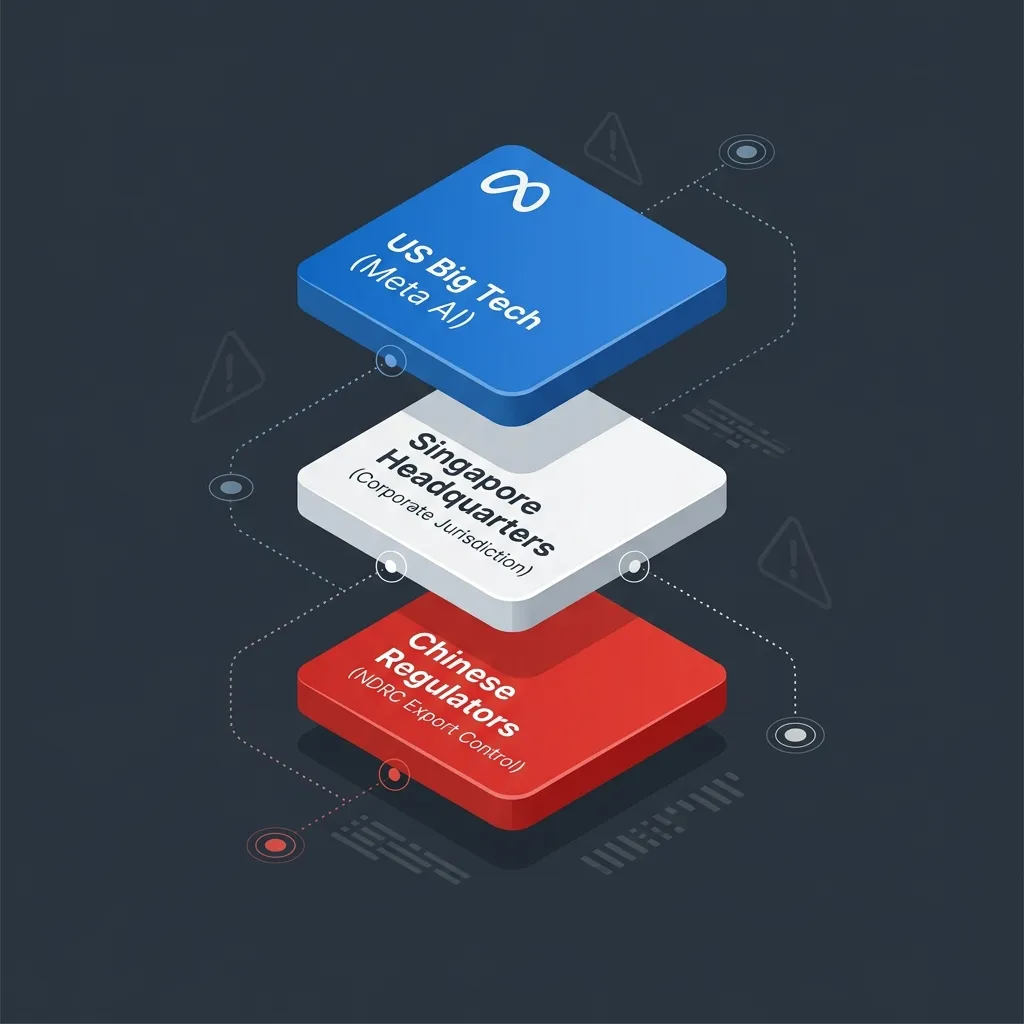
The legal basis for the block centered on national security and technology export controls. The NDRC’s intervention established several precedents:
1. The Singapore Headquarters Challenge
In early 2025, anticipating regulatory friction, the founders of Manus AI had formally incorporated in Singapore, shifting their headquarters and key intellectual property registration outside of China. This is a common play for startups looking to attract Western venture capital and avoid geopolitical entanglements.
However, the NDRC ruled that because the core algorithms, early-stage research, and founding engineering talent originated in China, the technology remained subject to the Chinese Export Control Law. Regulators asserted jurisdiction over the asset transfer, stating that the cross-border sale of advanced autonomous agent technology to a US tech giant constituted an unauthorized export of national security-sensitive technology.
2. The First Unwinding of a Consummated Deal
Typically, antitrust and national security reviews block transactions before they close. In this case, the NDRC ordered the unwinding of a deal that had already been finalized and integrated. This forced Meta to begin separating the systems:
- Restricting Manus employees from accessing Meta’s internal repositories and monorepos.
- Separating shared datasets and training pipelines.
- Sunsetting the collaborative features that were already in development for Meta AI.
The ruling sent a clear message: restructuring and relocation to neutral hubs like Singapore or London would no longer shield Chinese-founded deep-tech startups from Beijing’s regulatory reach.
What Is the Tencent and Sequoia China Buyback Play?
As Meta began unwinding the acquisition in May 2026, Manus AI’s future hung in the balance. The startup couldn’t simply return to its pre-acquisition state. It had lost its capital injection and was cut off from Meta’s infrastructure.
In June 2026, a consortium of domestic Chinese VC firms and tech giants stepped in to execute a rescue buyback. Led by Tencent, Sequoia China, and ZhenFund (an early backer of Manus), the consortium offered to purchase Meta’s shares and assets in Manus AI for the original $2 billion valuation.
This buyback makes sense for all parties:
- For Tencent: Tencent gets a world-class autonomous agent framework to integrate into WeChat and its enterprise software suite (WeCom). In China, WeChat is the operating system for daily life. An agent that can navigate mini-programs, manage corporate workflows, and interact with the WeChat ecosystem is a massive competitive advantage.
- For Sequoia China and ZhenFund: Reclaiming control of Manus keeps one of the most promising AI startups of the decade within the domestic Chinese ecosystem, and prevents a total loss of talent and IP.
- For Meta: While a strategic disappointment, the buyback lets Meta to recoup its $2 billion cash outlay, minimizing the financial write-down of the blocked transaction.
The consortium plans to pivot Manus AI away from the global consumer market and focus on domestic enterprise automation. The technology will be redeployed to automate supply chain logistics, municipal administration, and corporate back-office workflows within China, on domestic cloud infrastructure and hardware.
How Does This Fragment the Global AI Agent Race?
The collapse of the Meta-Manus deal is a watershed moment that signals the end of the open, global AI ecosystem. As we move through 2026, we’re watching two parallel, isolated AI agent landscapes emerge: the US and the Chinese.
┌─────────────────────────────────────────────────────────────────────────┐
│                     THE FRAGMENTED AI AGENT LANDSCAPE                   │
└─────────────────────────────────────────────────────────────────────────┘
         │                                                         │
         ▼                                                         ▼
┌──────────────────────────────────┐             ┌──────────────────────────────────┐
│        WESTERN ECOSYSTEM         │             │        DOMESTIC ECOSYSTEM        │
│    (US-Hosted Cloud & Local)     │             │    (Chinese Cloud & Hardware)    │
├──────────────────────────────────┤             ├──────────────────────────────────┤
│ • OpenAI Operator / GPT-5        │             │ • Manus AI (Tencent-Backed)      │
│ • Claude Code / Anthropic        │             │ • WeChat Agent Integration       │
│ • Cursor / Local Terminal IDEs   │             │ • DeepSeek / Qwen Agent Runtimes │
│ • Open-Source (Docker Sandbox)   │             │ • Domestic Enterprise VMs        │
└──────────────────────────────────┘             └──────────────────────────────────┘
         │                                                         │
         ▼                                                         ▼
┌──────────────────────────────────┐             ┌──────────────────────────────────┐
│   REGULATORY & INFRASTRUCTURE    │             │   REGULATORY & INFRASTRUCTURE    │
├──────────────────────────────────┤             ├──────────────────────────────────┤
│ • AWS / Google Cloud / Azure     │             │ • Tencent Cloud / Alibaba Cloud  │
│ • US Export Controls (H100/B200) │             │ • NDRC Technology Export Bans    │
│ • GDPR & Western Privacy Laws    │             │ • Domestic Data Security Laws    │
└──────────────────────────────────┘             └──────────────────────────────────┘
This fragmentation has implications for developers, enterprises, and the technology:
1. Divergent Runtimes and Sandboxes
US agents (like Claude Code and OpenAI’s Operator) are optimized for Western cloud services, Google Workspace, Microsoft 365, GitHub, Slack. They run on AWS, GCP, or Azure.
Chinese agents (reclaimed by the Tencent-backed consortium) will be optimized for the WeChat mini-program ecosystem, Alibaba Cloud, Baidu, and domestic databases. The underlying sandbox runtimes will diverge, An agent script written for a Western VM may not run on a domestic Chinese container due to differing OS dependencies, network gateways, and security protocols.
2. The End of Cross-Border Deep-Tech M&A
The NDRC’s block established that any advanced AI startup with Chinese founding roots is effectively locked out of acquisition by US tech firms, regardless of where it’s headquartered. Conversely, US regulatory bodies (like CFIUS) are equally aggressive in blocking Chinese investment in US AI.
Startups must choose their geopolitical alignment from day one. There’s no longer a path to a global exit through foreign acquisition.
3. Acceleration of Open-Source Local Sandboxing
With cloud acquisitions blocked and corporate platforms fragmenting, developers are turning to local-first, open-source agent frameworks (like OpenClaw and AutoGPT) that run inside local Docker containers. By keeping the sandbox local, developers bypass both geopolitical export controls and cloud credit costs, maintaining complete sovereignty over their data and code.
Summary
In this deep dive, we covered:
- Meta’s Strategic Intent: Why Meta sought to acquire Manus AI for $2 billion in December 2025 to leapfrog consumer-grade browser and desktop automation.
- The Core Value of Manus: How the startup’s virtualized sandbox, vision-verification loop, and reinforcement learning datasets made it a prized asset.
- The Geopolitical Block: How China’s NDRC asserted jurisdiction in April 2026, ruling that Singapore incorporation didn’t exempt the Chinese-founded company from domestic technology export controls.
- The Rescue Buyback: How a Tencent and Sequoia China-backed consortium stepped in during June 2026 to reclaim Manus and pivot to domestic enterprise automation.
- The Divided Frontier: What this landmark unwinding means for the fragmentation of the global AI agent landscape and the rise of local-first development.
Frequently Asked Questions
Did Meta lose its $2 billion investment when the deal was blocked?
No. The June 2026 buyback consortium led by Tencent, Sequoia China, and ZhenFund bought the shares and assets back from Meta for the original $2 billion valuation. This let Meta to recover its capital outlay, preventing a direct write-down, though it’s a massive strategic setback in their agent roadmap.
Can developers outside of China still use Manus AI?
Yes, but the roadmap has shifted. While the public cloud platform remains reachable, but the core developer team is transitioning to domestic enterprise integrations. For Western developers, the focus has shifted to native US alternatives (Claude Code, Cursor, OpenAI Operator) or open-source local frameworks (like OpenClaw).
Why didn’t Singapore’s legal jurisdiction protect the deal?
While Manus AI was legally incorporated in Singapore, the NDRC’s ruling focused on the origin of the technology and the nationality of the founders and core engineering team. Since the core IP and early algorithms were developed in China, regulators asserted that transferring these assets to a US entity violated Chinese technology export laws.
What to Read Next
- The Complete Manus AI Mastery Guide — Get the full tutorial on how to operate and configure the Manus VM and desktop agent.
- 15 Real-World Manus AI Use Cases — Explore how professionals deploy autonomous agents for market research and prototyping.
- Manus AI Alternatives: Complete 2026 Comparison — Compare the top 15 alternatives across pricing, privacy, and local execution.